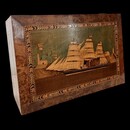
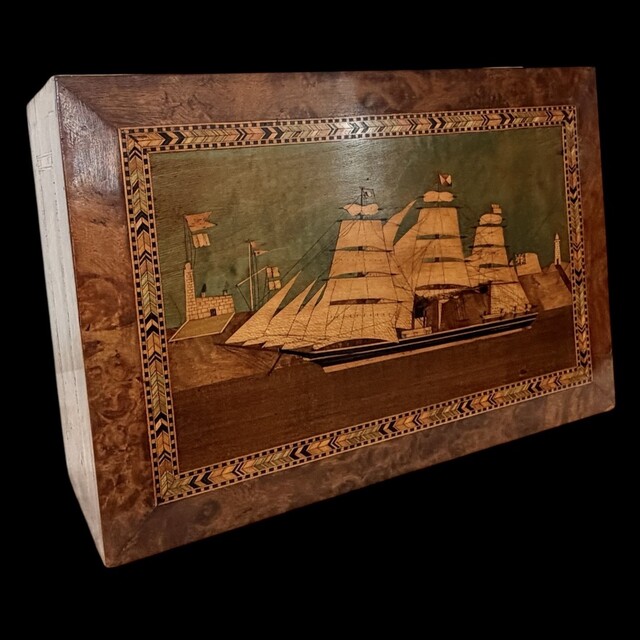
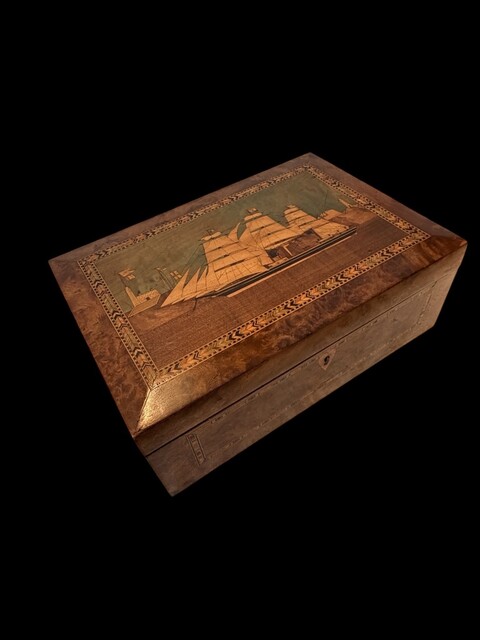
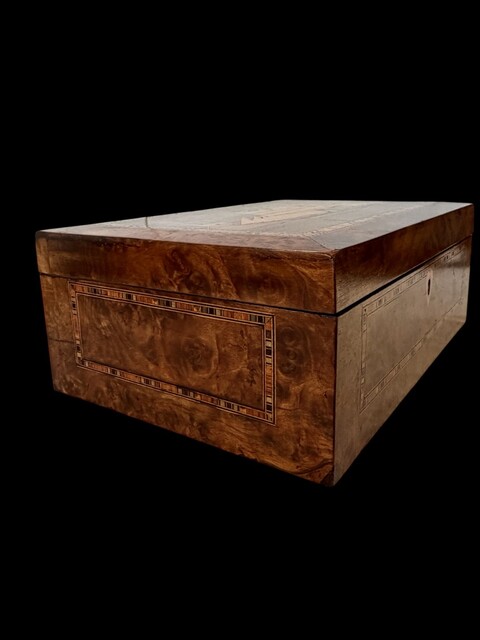
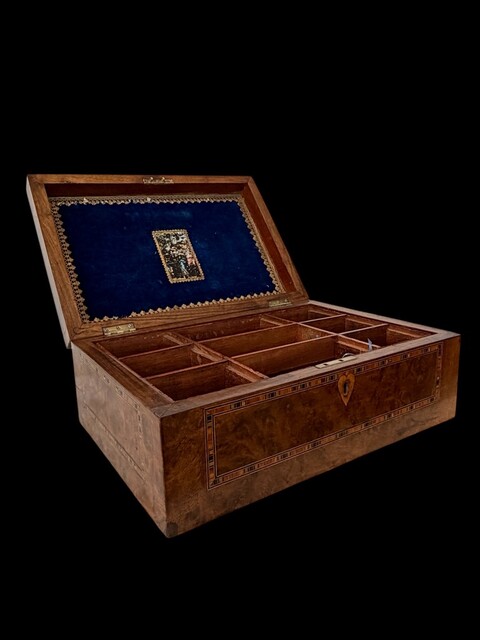
A Victorian English Trinity House Box in burr walnut with maritime marquetry, geometric parquetry borders and a fitted interior, dating from the mid 19th century.
Historical Background
Trinity House, officially The Corporation of Trinity House of Deptford Strond, was founded by Royal Charter in 1514 by King Henry VIII. For more than five centuries it has been responsible for the safety of navigation around the coasts of England and Wales, maintaining lighthouses, lightships, buoys and navigational marks. Its headquarters have been located at Tower Hill, London, since the late 18th century, overlooking the River Thames and the Tower of London.
Modern research indicates that the finest Trinity House Boxes were not produced by highly skilled cabinet makers and specialist woodworkers in important maritime centres such as Great Yarmouth, Bristol and London. These boxes were made for sale to sea captains, shipowners, merchants and senior officials connected with Trinity House, serving as prestigious presentation boxes, document boxes or personal keepsakes.
Their distinctive decoration reflects Britain's maritime heritage. The lids are typically inlaid with finely executed sailing ships, often representing merchant vessels or naval frigates, accompanied by lighthouses, harbour buildings and coastal fortifications associated with the work of Trinity House. The surrounding geometric borders, composed of intricate chevron, herringbone and parquetry patterns in contrasting timbers such as holly, mahogany, ebony and walnut, are among the defining characteristics of these remarkable boxes.
Produced mainly between 1840 and 1880, Trinity House Boxes represent some of the finest examples of Victorian English decorative woodwork, combining exceptional cabinet making with the rich maritime history of nineteenth century Britain.



 Request for more information
 See more items of this dealer
 Print
Print